
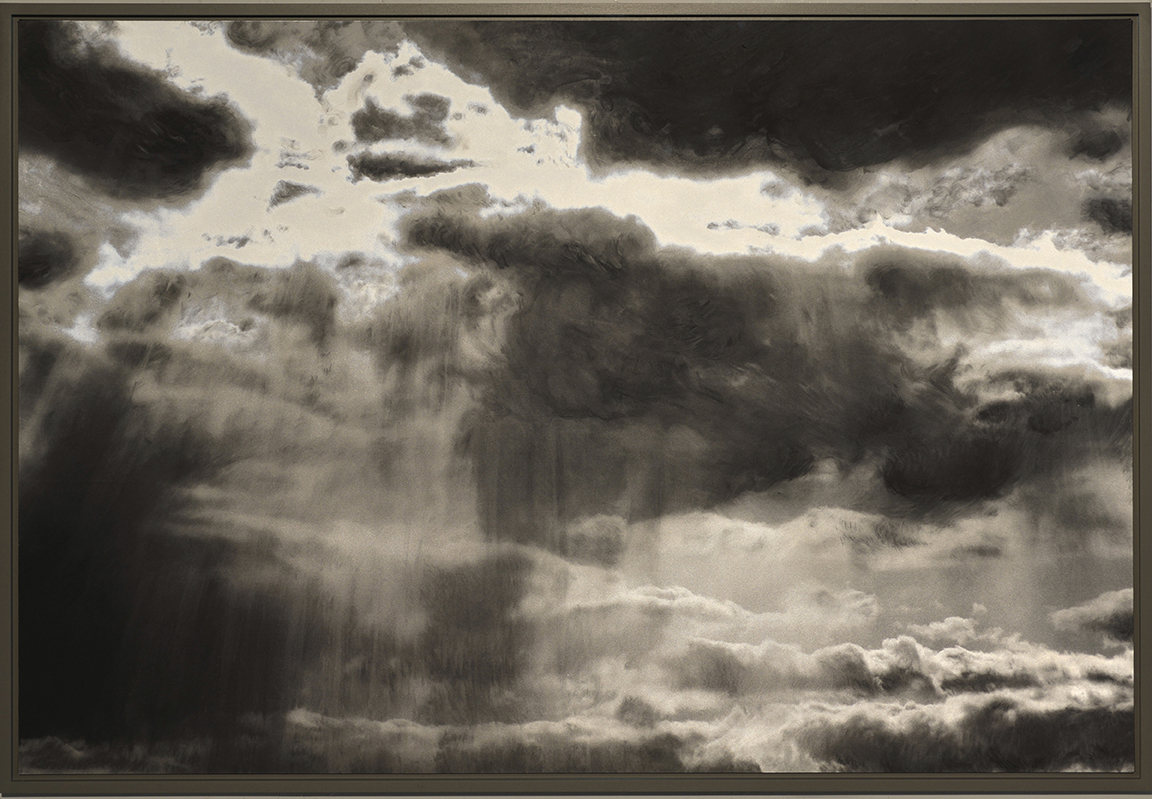
Bendana | Pinel Art Contemporain is pleased to present ‘‘Chroniques de la mer et d’une tempête’’, Miguel Rothschild’sfifth solo exhibition at the gallery.
A chronicle records events as they unfold over time. This exhibition invites us to interpret the sea and the sky in thisway: as witnesses to a time that defies representation, where the storm is as much an atmospheric phenomenon as astate of tension.
What unites these works is a shared exploration of the image. Here, photography is not a surface to be viewed fromthe outside, but something that transforms upon contact with the observer. In Cumulonimbus and Undercurrents, the images are printed on a reflective surface and reworked with charcoal directly over the photograph. The light seems toburst forth from the image as the viewer stands with their back to a light source, only to fade away as they move awayfrom it. The work changes with every movement and is never presented in quite the same way twice.
Destellos Nocturnos (Hallig Hooge) illustrates how a photographic print has been transformed into a field ofexperimentation. Rothschild brings to life the reflection of the stars and their twinkling on the water’s surface using rhinestones, as if the stars had descended to earth.
The surface, the frame and the glass are no longer mere accessories, but are now an integral part of the work, particularly in the case of Ocean Crack. The safety glass protecting the photograph is shattered, mirroring the movement of thewater. The fracture, like a wound, offers a glimpse behind the façade of a seductive image: the sea, which is at once a boundary, a shipwreck and a grave.
In Le deuxième principe d’Hermès Trismégiste, the glass becomes an agent of fiction. The image of a waterside landscape, rotated 180 degrees vertically, has been framed by two types of glass: standard glass in the upper part of the image, and another imitating water in the lower part. As if it were a reflection of a reflection.
This instability pervades the entire exhibition. The real reflection is accompanied by a simulated one; the landscape isinverted; the image flickers on and off. In every case, what we see depends on a shift: that of the body, of light, of the gaze. Nothing is definitive, nor is anything fully revealed.
By bringing together stormy skies, lakes and agitated seas, the exhibition transforms the landscape into a place of doubt, duality and tension rather than certainty. The sea and the sky function as mirrors that reflect one another, without it being possible to determine which is the original, and the beauty they offer always carries an implicit danger. Faced with them, the act of looking ceases to be passive and becomes an unstable experience.